Ant reports on his latest research on climate change.
recorder here:
http://www.hennievandyk.com/ANT/Global_Temperature_20111030.html
Thursday, November 03, 2011


Saturday, February 06, 2010
CLIMATE CHANGE
Ant, my son, writes to me from time to time from his hometown in Philadelphia, USA and the following is part of his recent letter.
I value his views particularly as a Senior Scientist and pleased of his reasoning on this issue having held simular views for many years, mind you I haven't done the research he has.
I've spent some time reading up on what is going on with global warming after the release of emails and documents from the CRU at the University of East Anglia. Previously I was inclined to give the experts, a la Al Gore, the benefit of the doubt and accept the global warming conclusion without doing much research of my own.
Regardless of global warming (or cooling) I still think it is prudent, and just plain common sense, to look after our environment and minimize our impact. So energy efficiency, reducing pollution, reducing the burning of fossil fuels, preservation of forests and natural habitats, are all aims I support and think governments and companies should be doing more to support.
What I've found from digging into global warming is that it isn't true.
For one thing temperature data has been cherry picked, massaged, and politically interpreted by some people to support their global warming hypothesis.
When I look at broader data sets and raw data, without fudging selected data and omitting other data, you find there is no warming trend, and most likely there has been a cooling trend over the past 5-10 years. Another thing too is that our life on earth depends upon a greenhouse effect of about +33°C, without which the global average temperature would be -18°C instead of the +16°C it currently is.
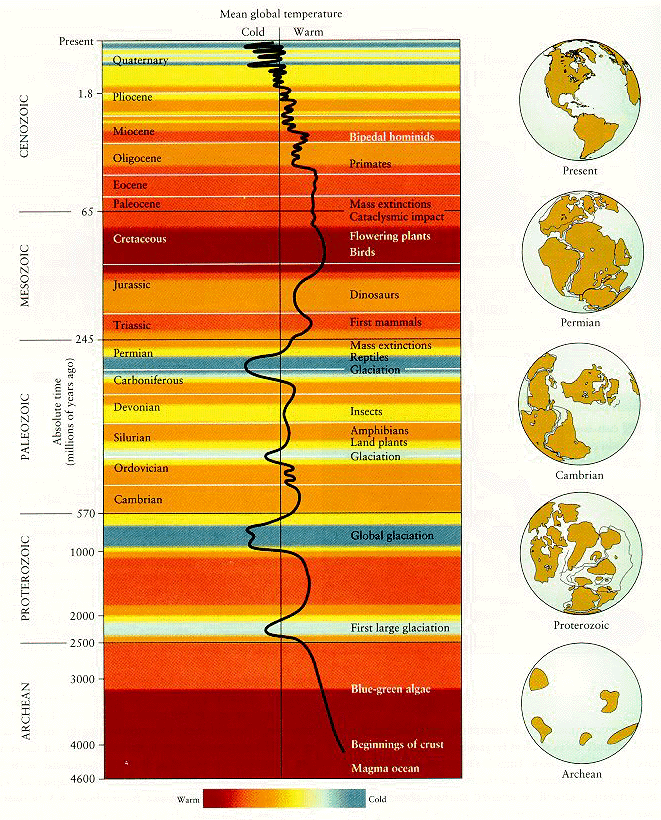
Historically CO2 levels are lower now than they have been for millions of years, and the temperature is also less than it has been for most of the past 600 million years (apart from a few brief cold spots). Over the past 600 million years the global average temperature has fluctuated between 10 and 25°C.
The average temperature over the past 600 million years has been around +18°C, and the average CO2 concentration has been about 8x what it currently is. Temperature has fallen steadily from around +22°C to its present value over the past 50 million years, and CO2 has fallen steadily from 8x to its current level over the past 150 million years. There is a case for expecting the CO2 and temperature to be higher and closer to the norm.
The second problem I've found is that the hypothesis that increased CO2 causes increased temperature is also almost certainly not true, and is definitely not true in the simplistic way that it is presented in the media. When CO2 and temperature data are compared it is clear that CO2 increases have historically occurred with a lag of at least 5-10 years following temperature increases.
In a simple system (like a closed box) you can calculate that an increase in CO2 will result in an increase in absorbed radiation and consequently an increase in temperature; and I agree with these calculations. But the problem is that in a real world case the calculations are too complex and can't be solved (at least not with current knowledge and not without many assumptions and fudge factors and simplifications). Since historical data show that CO2 increases happen after temperature increases, you can't conclude that increasing CO2 will cause an increase in temperature. There's more conflicting data, such as tree ring data, tree growth, and temperature being found to correlate with cosmic rays; solar output variability correlating with temperature; the effects of volcanic activity correlating with CO2 and temperature; and recent reports that anthropogenic CO2 is rapidly removed from the atmosphere.
I think what's happened has been collusion between environmentalists and speculators, and politicians have jumped on the bandwagon to further their own ambitions for power and money.
There's trillions to be made trading carbon credits, and there are now new financial instruments (like the infamous credit default swaps) for speculators to gamble with. For a scientist, the goal is to dispassionately record and analyze data. In global warming the stakes are high (doing good or making tons of money, or both), and the problem is so complex that no one really knows how to make a valid model.
I think many of the scientists involved have allowed their ambition (for career, doing good, or profit) to cloud their judgment, much like Shakespeare's Macbeth. Sadly, I think it makes all scientists and science look bad and undermines motivation to reduce emissions, including CO2, reduce waste, and take better care of the environment.
Comments by Ant Van Dyk Ph.D
February 2010
References
- http://www.ruf.rice.edu/~leeman/GeoColumn.gifClimate change Graph
- http://blogs.telegraph.co.uk/news/jamesdelingpole/100022226/agw-i-refute-it-thus-central-england-temperatures-1659-to-2009/
- http://www.marketoracle.co.uk/Article16126.html
- http://www.canadafreepress.com/index.php/article/18343
- http://theresilientearth.com/?q=content/grand-view-4-billion-years-climate-change
- icecap.us/images/uploads/A_CHILLY_DECEMBER_AT_THE_700_MB_LEVEL.pdf
- http://snardfarker.ning.com/forum/topics/new-research-into-greenhouse?groupUrl=globalwarmingclimatechangeforum&commentId=2649739%3AComment%3A148950&xg_source=activity&groupId=2649739%3AGroup%3A9813
- http://www.met.hu/idojaras/IDOJARAS_vol111_No1_01.pdf
- http://strata-sphere.com/blog/index.php/archives/13134
- http://hockeyschtick.blogspot.com/2010/03/dr-nils-axel-morners-reply-to-maldives.html
- http://wattsupwiththat.com/2010/04/13/lies-damned-lies-statistics-and-graphs/
- http://globalwarminghoax.wordpress.com/2009/12/15/climate-change-is-natural-100-reasons-why/
- http://blogs.telegraph.co.uk/news/
jamesdelingpole/100032069/only-global-fascist-tyranny-can-save-us-now-says-nice-old-man/
Wednesday, November 04, 2009
Wildlife in the Scenic Rim
Have a look at the Website of the new branch of Scenic Rim Wildlife Society we are trying to establish.
Following the merger of several Shires the Scenic Rim newly formed Regional Council covers a large area Southwest of Brisbane, Queensland, Australia with interesting wildlife.
Wednesday, June 10, 2009
Doctors Raise My Blood Pressure
This article is about my experience with Doctors about Blood Pressure measurement and my aversion to take medication unless patently necessary.
At my last birthday I was required to renew my medical certificate to allow me to continue to drive my car. Here in Australia when you reach 75 you have to prove that you are entitled to drive. When visiting my GP for this purpose he gives me an eye test, BP measurement and we have a brief discussion—he handed over the certificate and the visit was over within ten minutes.
As he was on holiday, I saw my wife Margaret's GP instead; not so with this visit. Half an hour later we came to the BP test which showed a somewhat higher number this visit. We had a brief discussion: no I did not prefer medication unless essential, I was in very good health, the figure was about what it had been for many years, but I understood that when getting older the rate usually would gradually increase.
She was having none of that, insisting to put me on a low dose of medication to start and would review me in a week’s time to assess the level of medication required she then completed the certificate which basically reveals that I am fit to drive my car and see a doctor on a regular basis.
A week later, no change in the BP level. She insisted she put me on a full dose.
Another week later the BP was not much different.
I was having difficulty understanding what she was saying with her Asian accent. In time, Margaret explained that the doctor said I had “the white coat syndrome”. I was pleased that she suggested we buy a BP machine. A week later, back with the doctor, my recorded information showed variable but very reasonable results and I suggested going without the medication but reluctantly accepted a reduction only.
As I join Margaret in her appointments with her doctor on other than routine visits, she knew me well enough, but her method of doctoring did not sit well with me. In time I gathered the courage to go back to my old GP, her partner in the next room, and discussed my wish to keep medication to a minimum or (preferably do without).
His approach was “fair enough”. Stay on the half medication, keep regular records, if it goes up too much double the medication, see me in a month’s time, earlier if I wanted to.
At the visit a month later reviewing the recorded data, he found the results excellent, suggesting I stay on the low half dose medication and if the downward trend continued I could go of the medication altogether. After a brief further discussion I was out of his office within 10 minutes.
I had investigated hypertension on the Internet and gained the impression that the current trend was if testing anyone above 120/80 put the patient on medication and better still reduce this rate, the lower the better.
More research by me on the Internet revealed comments by several Specialists:
• Don't automatically medicate and avoid to prescribe if possible.
• Treat each case on it's own.
• They view nothing wrong with 130/90 (I'm below that).
I am a very independent person preferring to be in personal control of myself and that includes my health and see my Dr (GP in particular) as a consultant. I need to decide. Back to my Doctor experience, I assured Margaret it was not a male versus female problem but that Doctors need to listen carefully to what their patients want.
My GP is a Belgian, long time resident with fluent English.
Margaret's GP is of Asian descent and you can only understand what she says by working hard at it.
I feel Doctors of any nationality are fine but effective communication when consulting is paramount, and this is where our Health System is letting us down. It can't be too hard to ensure appropriate training in speaking English. (Who is talking? A Dutchman who had to learn communicate in the English language.)
At my last birthday I was required to renew my medical certificate to allow me to continue to drive my car. Here in Australia when you reach 75 you have to prove that you are entitled to drive. When visiting my GP for this purpose he gives me an eye test, BP measurement and we have a brief discussion—he handed over the certificate and the visit was over within ten minutes.
As he was on holiday, I saw my wife Margaret's GP instead; not so with this visit. Half an hour later we came to the BP test which showed a somewhat higher number this visit. We had a brief discussion: no I did not prefer medication unless essential, I was in very good health, the figure was about what it had been for many years, but I understood that when getting older the rate usually would gradually increase.
She was having none of that, insisting to put me on a low dose of medication to start and would review me in a week’s time to assess the level of medication required she then completed the certificate which basically reveals that I am fit to drive my car and see a doctor on a regular basis.
A week later, no change in the BP level. She insisted she put me on a full dose.
Another week later the BP was not much different.
I was having difficulty understanding what she was saying with her Asian accent. In time, Margaret explained that the doctor said I had “the white coat syndrome”. I was pleased that she suggested we buy a BP machine. A week later, back with the doctor, my recorded information showed variable but very reasonable results and I suggested going without the medication but reluctantly accepted a reduction only.
As I join Margaret in her appointments with her doctor on other than routine visits, she knew me well enough, but her method of doctoring did not sit well with me. In time I gathered the courage to go back to my old GP, her partner in the next room, and discussed my wish to keep medication to a minimum or (preferably do without).
His approach was “fair enough”. Stay on the half medication, keep regular records, if it goes up too much double the medication, see me in a month’s time, earlier if I wanted to.
At the visit a month later reviewing the recorded data, he found the results excellent, suggesting I stay on the low half dose medication and if the downward trend continued I could go of the medication altogether. After a brief further discussion I was out of his office within 10 minutes.
I had investigated hypertension on the Internet and gained the impression that the current trend was if testing anyone above 120/80 put the patient on medication and better still reduce this rate, the lower the better.
More research by me on the Internet revealed comments by several Specialists:
• Don't automatically medicate and avoid to prescribe if possible.
• Treat each case on it's own.
• They view nothing wrong with 130/90 (I'm below that).
I am a very independent person preferring to be in personal control of myself and that includes my health and see my Dr (GP in particular) as a consultant. I need to decide. Back to my Doctor experience, I assured Margaret it was not a male versus female problem but that Doctors need to listen carefully to what their patients want.
My GP is a Belgian, long time resident with fluent English.
Margaret's GP is of Asian descent and you can only understand what she says by working hard at it.
I feel Doctors of any nationality are fine but effective communication when consulting is paramount, and this is where our Health System is letting us down. It can't be too hard to ensure appropriate training in speaking English. (Who is talking? A Dutchman who had to learn communicate in the English language.)
Saturday, May 31, 2008
HAPPY EXPERIENCE
Great positive experience by one of my friends.
_______________________________________________________________________
Today I parked at the supermarket; I squeezed in between a huge 4WD vehicle on one side and on the other was a dividing ,raised cement partition about 6 inches high or so.
When I came to leave and to reverse out, first my front tyre then my back kept hitting the cement. I went back and forth, cussing quietly.
Then I heard a voice, 'You seem to be having a bit of difficulty; let me guide you out.' He was a young man, maybe in this thirties. He stood in front and called me through the wheel turnings until I was out and clear.
I thanked him very sincerely for his kindness and consideration; typically Aussie he laughed and replied 'No worries, Mate,' and walked off.
He need not have bothered; he could have ignored me and walked straight into the Supermarket; or got in his car and driven off. Instead he saw my plight, changed direction completely and walked over to me to help. His thoughtfulness touched me.
Isn't it nice, in these days of violence and selfishness and inconsiderate behaviour, to suddenly come across this simple action of unsolicited kindness?
_______________________________________________________________________
Today I parked at the supermarket; I squeezed in between a huge 4WD vehicle on one side and on the other was a dividing ,raised cement partition about 6 inches high or so.
When I came to leave and to reverse out, first my front tyre then my back kept hitting the cement. I went back and forth, cussing quietly.
Then I heard a voice, 'You seem to be having a bit of difficulty; let me guide you out.' He was a young man, maybe in this thirties. He stood in front and called me through the wheel turnings until I was out and clear.
I thanked him very sincerely for his kindness and consideration; typically Aussie he laughed and replied 'No worries, Mate,' and walked off.
He need not have bothered; he could have ignored me and walked straight into the Supermarket; or got in his car and driven off. Instead he saw my plight, changed direction completely and walked over to me to help. His thoughtfulness touched me.
Isn't it nice, in these days of violence and selfishness and inconsiderate behaviour, to suddenly come across this simple action of unsolicited kindness?
Monday, April 21, 2008
AUSTRALIA 2020 SUMMIT
THE VOICE OF THE PEOPLE
I have been following the 2020 conference with interest, but have been amazed by the many adverse, negative comments about the conference in the Courier Mail Newspaper 'on-line' comments. Sure a proportion seem to be political based comments but what surprised me was the lack of acknowledgment of "here is a different new Idea and a Prime Minister willing to stick his neck out and offering to be accountable. Why not 'give the bloke a fair go', is that not the Australian's claim?".
My bias? - 76 year old, born in Holland, 20 years naturalized Australian, belonging to no political party. For what it is worth I offer my opinion as follows.
As one of the most Democratic Countries in the world, Kevin Rudd's party was elected by a significant majority. Clearly a change in direction was wanted by the majority of people and to actually engage the the population via the conference, to tell him what they want was a refreshing idea rather than to be told pull your head in and do as you are told.
The least is the exposure of the Prime Minister's views for Australia - 'these are my views of the future please add to them to make them better'.
Are some of the ideas proposed, not new, borrowed?, if so what, if you think they are OK how else do you get them, from a 2020 conference is as good an idea as any, have any better ideas? then use the Web site to add them.
There are 1000+ very positive people going back home promoting a positive outlook for the future and keen to be part of that outcome, that in itself is a good outcome.
That's just my view.
Hennie van Dyk
I have been following the 2020 conference with interest, but have been amazed by the many adverse, negative comments about the conference in the Courier Mail Newspaper 'on-line' comments. Sure a proportion seem to be political based comments but what surprised me was the lack of acknowledgment of "here is a different new Idea and a Prime Minister willing to stick his neck out and offering to be accountable. Why not 'give the bloke a fair go', is that not the Australian's claim?".
My bias? - 76 year old, born in Holland, 20 years naturalized Australian, belonging to no political party. For what it is worth I offer my opinion as follows.
As one of the most Democratic Countries in the world, Kevin Rudd's party was elected by a significant majority. Clearly a change in direction was wanted by the majority of people and to actually engage the the population via the conference, to tell him what they want was a refreshing idea rather than to be told pull your head in and do as you are told.
The least is the exposure of the Prime Minister's views for Australia - 'these are my views of the future please add to them to make them better'.
Are some of the ideas proposed, not new, borrowed?, if so what, if you think they are OK how else do you get them, from a 2020 conference is as good an idea as any, have any better ideas? then use the Web site to add them.
There are 1000+ very positive people going back home promoting a positive outlook for the future and keen to be part of that outcome, that in itself is a good outcome.
That's just my view.
Hennie van Dyk
Thursday, November 08, 2007
GLOBALIZATION
At last I now understand globalization!!!
Finally, a definition of globalization
I can understand and to which
I can relate:
Question : What is the truest definition of Globalization?
Answer : Princess
Diana's death.
Question : How come?
Answer :
An English princess with
an Egyptian boyfriend
crashes in a French
tunnel, driving a
German car
with a Dutch engine,
driven by a Belgian
who was drunk
on Scottish whisky,
(check the bottle before you change the spelling),
followed closely by
Italian Paparazzi,
on Japanese motorcycles,
treated by an American doctor, using
Brazilian medicines.
This is sent to you by
a Canadian,
using Bill Gates' technology,
and you're probably reading this on your computer,
that uses Taiwanese
chips, and a
Korean monitor,
assembled by
Bangladeshi workers
in a Singapore plant,
transported by Indian
lorry-drivers,
hijacked by Indonesians,
unloaded by Sicilian longshoremen,
and trucked to you by Mexican illegals.....
That, my friends, is Globalization!
Subscribe to:
Posts (Atom)